Greetings and salutations!
A quick note: I was on a podcast recently, having a wide-ranging discussion on learning! The ideas in the podcast flow from my general thinking on learning, connecting the theoretical ideas with practical solutions — I hope you enjoy!
A Story
Have you ever tried to get Play-Doh out of clothes?
With two small children, getting Play-Doh out of clothes has become a reality in my life. I’ve learned that not all Play-Doh is the same, with the consistency changing from box to box. The Play-Doh can be solid and squishy or slimy and sticky, with any combination in between — making the process of getting Play-Doh out of clothes challenging!
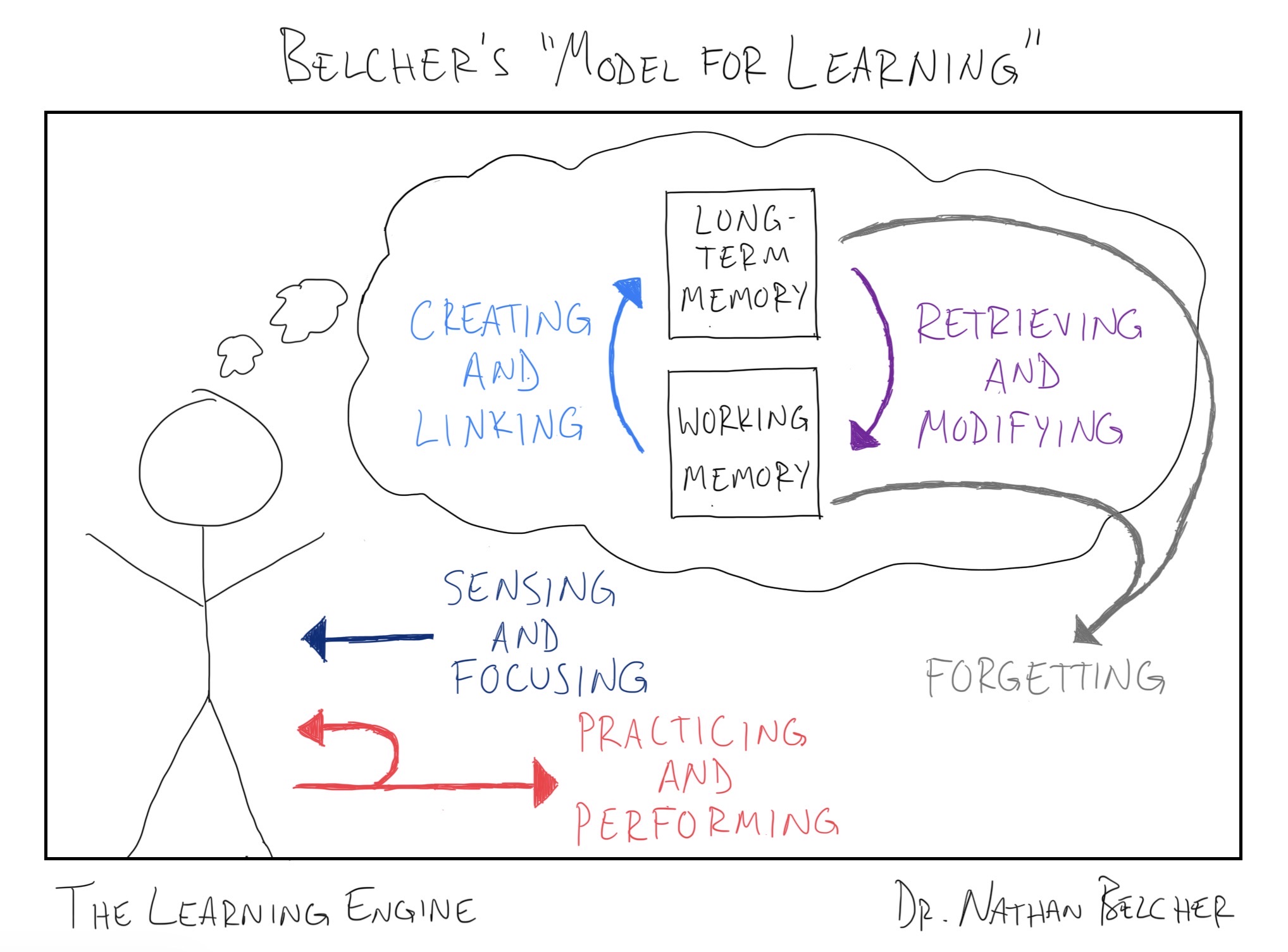
While attempting to pick out the Play-Doh from a pair of leggings recently, I realized that there was probably a better way; I needed to apply my own Model for Learning to this situation. My conceptual model for cleaning Play-Doh from clothes was lacking detail, so I found a couple of articles that described the process of removing Play-Doh from clothes. I followed the directions of soaking the leggings in hot water for a bit, then using soap to get out the rest of the Play-Doh.
The process worked, giving us a clean pair of leggings — and creating a much richer conceptual model for cleaning Play-Doh in my brain!
Before a discussion of the lessons from the Play-Doh story, please consider my Model for Learning. Work yourself through the model, thinking about specifics for each part.
[For a much deeper explanation on the process of learning, check out this essay: That’s How Learning Works?!?! A Comprehensive Model for Understanding the Learning Process.]
Lessons
Although the Play-Doh story is relatively simple, the story illustrates the process of learning.
- Input Activities bring information for knowledge and skills into our conceptual models — through “Sensing and Focusing” and feedback from “Practicing and Performing.”
- Processing Activities help build and organize the knowledge and skills in our conceptual models — through “Creating and Linking” and “Retrieving and Modifying.”
- Output Activities use the knowledge and skills in our conceptual models in some way — through “Practicing and Performing.”
[This newsletter will focus on Input Activities; we will discuss the Processing Activities and Output Activities in the next couple of newsletters.]
There different ways to do Input Activities:
- Read articles, essays, check-lists, or books.
- Watch videos.
- Listen to audio.
- Study examples that are similar to or exactly match your situation.
- Have conversations with peers or leaders.
Each way brings information for knowledge and skills into our conceptual models, confirming or updating the knowledge and skills based on what we already have stored in our long-term memory. We can also use different ways to think about a situation from many angles, increasing the knowledge and skills for the conceptual models in the situation.
There is another part to the Input Activities — considering the sequence and complexity of the information. I was a novice at getting Play-Doh out of clothes, so the information needed to be simple and straightforward. However, I’m an expert in other domains; in these domains, I can take in the information in different sequences and plus deal with a high complexity. We need to be aware of the sequence and complexity relative to our current ability, using tools to get the information into a realm where we can connect the new information to the knowledge and skills in our conceptual models.
By connecting the information in high-quality Input Activities to our current understanding, we can improve our understanding — and move through the rest of the learning process to use our understanding in interesting ways!
Questions for the Next Steps
- What is the quality of the information in your Input Activities?
- If the information is low-quality, how can you find resources that are more high-quality?
- How does the complexity of the information match your current understanding?
- If the complexity of the information is not close enough to your current understanding, what can you do to get the information close?
- If you default to one type of activity, how can you use other types of activities to expand your information?
Learning happens when we share what we are thinking, so I would love to hear your stories about learning through small moments and answers to the questions. Also, you can use these questions as conversations starters with friends and family — hearing their answers and having a conversation will help you deepen your relationships and gain more understanding!
If this newsletter resonated with you, please share on the socials and with someone who you think would also benefit; I would greatly appreciate any help in spreading these ideas!
Thanks for reading this newsletter — and all the best!
Nathan